
Mathematics at Yealand Church of England Primary School
At Yealand Church of England Primary School, we love mathematics and the challenges it brings. We view mathematics as essential to everyday life, critical to science, technology and engineering, and necessary for financial literacy too. We believe in providing a high-quality mathematics inclusive education, which develops from joy and curiousity of number into an ability to reason and challenge, once those important foundations are set. We believe that our Maths Curriculum enables all to achieve.
Using the National Curriculum programmes of study our aim is to develop:
- A positive attitude towards mathematics as an interesting and attractive part of the curriculum.
- Competence and confidence in mathematical knowledge, concepts and mastery built on solid foundations.
- An ability to solve problems, to reason, to think logically and to work systematically and accurately.
- Initiative and ability to work both independently and in cooperation with others.
- An ability to communicate mathematics.
- An ability to use and apply mathematics across the curriculum and in real life.
- An understanding of mathematics through a process of enquiry and experiment.
- Personal qualities such as perseverance, independent thinking, cooperation and self-confidence through a sense of achievement and success.
Implementation:
We implement our mathematics curriculum using planning and resources from White Rose Maths and NCETM. This ensures there is consistency and continuity across the whole school. Programmes of Studies for mathematics have been meticulously mapped accordingly to support the children within each cohort and have complete coverage for each learner. Some children are grouped and taught as Key Stages, while others are taught as individual year groups. Teachers are proficient in adapting plans to individual children so that they can access all learning.
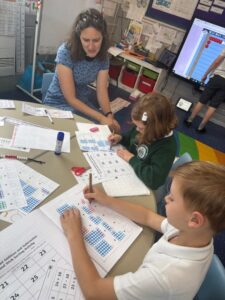
Staff use a range of teaching styles from individual, partner and group work; games and real life learning to develop children’s mental and written work, as well as their reasoning skills too.
We use daily mastery tasks to support our children’s understanding of number and encourage the development of their mathematical vocabulary.
For children in Key Stage 1 and 2, Mathematics is taught daily. Lessons last between 45-60 mins. Within each lesson, there is time with a teacher, an element of mental maths work, written maths work and an opportunity to consolidate learning through an independent task or game.
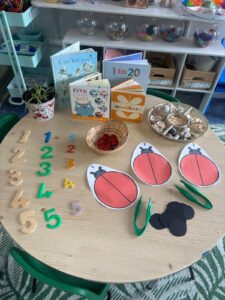
Little Owl’s children follow the Early Year’s Framework for Maths and therefore some of their lessons looks different. Maths can be found within their continuous provision. For e.g. there may be a till in the role-play shop, where the children practise exchanging money. They have small group or individual targeted time with an adult who is supporting them with the foundational learning of their maths knowledge and understanding.
Children are monitored and tracked thoroughly, so that teachers know exactly where children’s understanding is. This allows them to plan and resource for an individual’s next steps. If a child needs additional support, this happens quickly. Children may have interventions to help them narrow gaps, so that they can be confident with maths work in class and strengthen their foundational knowledge.
As part of our Statutory Duty, children are assessed in Mathematics throughout school. These assessments are reported to families as part their Early Learning Goals, End of Key Stage 1 data, the Year 4 Multiplication Check and Key Stage 2 SATs, as well as in a child’s annual end of year report.
Impact:
Children at Yealand love Maths and annually place the subject as their favourite subject taught.
Yealand’s successful approach to the teaching and learning of maths, results in a fun and engaging curriculum that embeds understanding and knowledge through hands on, practical activities as well as developing important recording skills.
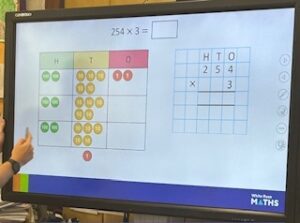
Introductions to concepts using concrete materials and practical activities supports learning through memorable activities and ‘games’ which children can recall at a later date, relating the learning to new situations.
If you would like to find out more about our Mathematics Curriculum, please contact Kathryn Brown (Maths Subject Lead.)
Mastering maths means pupils acquiring a deep, long-term, secure and adaptable understanding of the subject.
The phrase ‘teaching for mastery’ describes the elements of classroom practice and school organisation that combine to give pupils the best chances of mastering maths.
Achieving mastery means acquiring a solid enough understanding of the maths that’s been taught to enable pupils to move on to more advanced material.
NCTEM www.nctem.org.uk


 .
.
Parents Maths Workshop
We had a lovely morning welcoming families into school to share our journey of Maths with them.
We talked about the resources we use to support our children and gave tips of things they could try at home before taking a walk through Maths starting within our Early Years provision, through Key Stage 1 and then into Key Stage 2. We focused on number and calculations this time, but we will repeat the morning with a different Maths focus each time.